Chapultepec Castle Tours — June 5, 2026
Inside Chapultepec Castle: A Complete Guide to Every Room, Hall & Highlight
Most visitors spend 90 minutes inside Chapultepec Castle and leave feeling like they saw a lot of old furniture. This is the wrong way to visit. The castle's 22 rooms in the Alcázar wing — plus the museum halls, mural stairwells, and the Observatory Tower — tell a 500-year story if you know what you're looking at.
This guide walks through every major space in sequence, explaining what each room was used for, what's worth looking at, and what most visitors walk straight past. For even more depth, a guided chapultepec castle tour covers all of this with a local expert who can answer questions in real time.
The Alcázar Wing
The Alcázar is the oldest and most significant section of the castle — the wing that Emperor Maximilian and Empress Carlota renovated into a European-style imperial palace in the 1860s. It occupies the upper portion of the hill and contains 22 rooms across several floors, with the most important spaces on the upper level where the imperial apartments are located.
Room 1: The Entrance Hall
The formal entrance to the Alcázar sets the tone immediately. The floor is original 1860s tile — note the repeating eagle motif, which Maximilian adopted for the Second Mexican Empire, blending the Habsburg double-eagle with the Mexican golden eagle. The ceiling height and the proportions of the space were deliberately designed to impress arriving dignitaries. Most visitors walk through this room without stopping.
Don't miss: The ironwork on the main doors — imported from Belgium at Carlota's request, it incorporates the initial "C" for Carlota into the decorative pattern.
The Galería de Emplomados (Stained-Glass Gallery)
The most photographed interior space in the castle and the one that earns the most gasps on guided tours. The Galería de Emplomados is a long gallery lined with leaded stained-glass windows imported from France during Maximilian's renovation in the 1860s. Emplomados refers to the lead strips binding the glass — the same technique used in European cathedral windows since the medieval period.
At certain times of day — particularly 9:00 to 11:00 am — the coloured light falls across the stone floor in shifting patterns. The gallery runs along the eastern facade of the Alcázar, so morning light is at its strongest. Afternoon visits get warmer, lower light, which is also beautiful but different in character.
Don't miss: Stand at the far end of the gallery and look back toward the entrance — the perspective down the full length of coloured windows is the single best interior photograph in the castle.
Emperor Maximilian's Private Rooms
Maximilian's private apartments are on the upper floor of the Alcázar, positioned on the eastern side specifically so he could watch the sunrise over the Valley of Mexico each morning. He wrote in letters that this view — the city below, the snow-capped volcanoes on the horizon — was among the few things he genuinely loved about Mexico.
The Emperor's Study
Maximilian was an intellectual — botanist, naturalist, writer. His study reflects this. The bookshelves were custom-built to his specifications and housed a working collection, not decorative volumes. Several of his personal books remain on display. His writing desk is positioned toward the window rather than facing into the room — he worked facing the view.
The Emperor's Bedroom
Notably austere compared to the grandeur of the public rooms. Maximilian's bedroom is simply furnished — a single iron bed frame, plain walls, a small prayer kneeler. The contrast with the elaborate ceremonial spaces below is deliberate: he maintained a strict private/public separation. The bedroom also doubled as a workspace in the early mornings before official duties began.
Empress Carlota's Private Rooms
Carlota's chambers are adjacent to Maximilian's but strikingly different in aesthetic. Where his rooms are spare and functional, hers are elaborately decorated — Belgian-made furniture, heavy drapes, layered textiles. She grew up in the Palace of Laeken in Brussels, one of the grandest royal residences in Europe, and her rooms in Chapultepec Castle reflect that upbringing.
The Music Room
Carlota's piano — her original Belgian-made instrument — remains in the music room exactly where it was placed during the renovation. It is one of the most quietly moving objects in the castle: a functional instrument that a 24-year-old empress played in a palace on a hill in Mexico, now silent for over 150 years. The piano has never been moved from this room.
Don't miss: The small portrait of Carlota's father, King Leopold I of Belgium, on the mantelpiece. She was said to carry it everywhere she lived.
The Empress's Salon
The formal sitting room where Carlota received ladies of the imperial court. The furniture — chairs, tables, curtains — is largely original. The colour palette (deep greens and gold) reflects European court fashion of the 1860s. Note the ceiling decoration: Carlota had it painted with garlands of flowers, a style common in Belgian royal residences of the period.
The Sala de los Virreyes
One of the most historically significant rooms in the castle and one of the most underappreciated. The Room of the Viceroys contains 62 painted portraits of the colonial governors who ruled New Spain between 1535 and 1821 — every viceroy, in chronological order, each depicted in the same formal format: official dress, staff of office, identifying inscription below the frame.
The room functions as a visual register of three centuries of colonial administration. The sheer repetition — 62 nearly identical paintings covering all four walls — conveys the weight and duration of Spanish rule more powerfully than any text. This is one of the largest collections of viceregal portraiture in the Americas.
Don't miss: The portraits of Viceroy Bernardo de Gálvez (who commissioned the castle in 1785) and the last viceroy, Juan O'Donojú, who signed the Treaty of Córdoba recognising Mexican independence in 1821 — two of the most consequential figures in the room.
The Mural Stairwells
The castle's mural program is among its most important artistic assets, commissioned in the post-revolutionary decades to give the newly public museum a visual political argument. Three major works by three major artists:
Siqueiros: Del Porfirismo a la Revolución
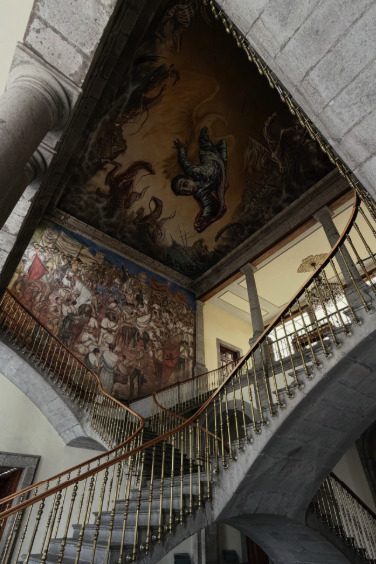
David Alfaro Siqueiros painted this massive work in the main stairwell between 1957 and 1966. The composition wraps around the curved walls and ceiling, depicting the arc from Porfirio Díaz's dictatorship through the Mexican Revolution. The technique — synthetic polymer on curved surfaces — was experimental at the time and remains in exceptional condition. Standing at the base of the staircase and looking upward is the most effective way to read the full composition.
O'Gorman: Sufragio Efectivo, No Reelección
Juan O'Gorman's retablo-style mural covers Mexican history from the Spanish conquest through the revolution, rendered in a visual language that deliberately references pre-Hispanic codices. The title — "Effective Suffrage, No Re-election" — was the slogan of Francisco Madero's revolution against Díaz, adopted by O'Gorman as an ironic commentary on the gap between revolutionary ideals and political reality.
Orozco: Juárez, la Iglesia y los Imperialistas
José Clemente Orozco's contribution depicts Benito Juárez's confrontation with the Catholic Church and foreign imperialism, with Maximilian shown being delivered to the firing squad. It is the most politically direct of the three murals — Orozco never softened his work for official audiences.
Book Historical Chronology Tour from $52 →
The Carriage Room
The carriage room is easy to underestimate. On the surface: two old vehicles behind barriers. In context: one of the most loaded juxtapositions in the entire castle.
Maximilian's state carriage is gilded, European-made, elaborate — exactly what you'd expect of a Habsburg emperor. Juárez's carriage — the vehicle that carried the republican president back into Mexico City after Maximilian's execution — is a plain black coach. Unpretentious by deliberate choice. Juárez was a Zapotec from rural Oaxaca who had studied law and risen to the presidency; he considered ostentatious display incompatible with republican values.
The two carriages were placed in the same room by the post-revolutionary museum specifically to make this contrast visible. It works.
The Caballero Alto (Observatory Tower)
The highest point of the castle and the best viewpoint in the complex. The Caballero Alto served as an astronomical observatory in the late 19th century — its elevation above the city made it ideal for observation before urban light and haze made this impractical. The instruments are gone, but the tower remains open.
From the top: a 360° panorama of Mexico City, with Chapultepec Forest spreading below and the city extending in every direction. On clear days — typically early morning from October through February — Popocatépetl and Iztaccíhuatl are visible on the southeastern horizon. The volcano views are worth timing your visit for.
Practical note: The stairs to the tower are narrow and steep. The tower is the last stop on most guided tours — your guide will tell you when and how to reach it.
The Gardens and Terraces
Empress Carlota redesigned the castle gardens in the 1860s, creating formal terraces modelled partly on the gardens of her childhood home, the Palace of Laeken in Brussels. The bougainvillea is spectacular in spring (March–April). The south-facing terrace offers views toward the mountains on clear days.
Most visitors spend all their time in the indoor rooms and skip the gardens — a mistake. Allow at least 20 minutes for the terraces, particularly if the weather is good. The combination of castle architecture, flowering plants, and distant city views makes this the best photography location in the complex.
Recommended Route and Timing
- 9:00 am — Arrive at opening. Buy ticket at base. Take tram or walk up.
- 9:15 am — Galería de Emplomados first — best light of the day.
- 9:45 am — Imperial apartments: Maximilian's rooms, then Carlota's (including the piano).
- 10:30 am — Sala de los Virreyes and the museum history halls.
- 11:00 am — Mural stairwells — Siqueiros, O'Gorman, Orozco.
- 11:30 am — Carriage room.
- 11:45 am — Caballero Alto tower for panoramic views.
- 12:00 pm — Gardens and terraces, then descend.
Total: approximately 3 hours for a thorough self-guided visit. With a guide, allow 2.5–3.5 hours depending on pace and questions. For the full combined visit with the Anthropology Museum, start at the museum at 9:00 am and reach the castle by midday.