Chapultepec Castle Tours — June 10, 2026
15 Facts About Chapultepec Castle That Will Surprise You
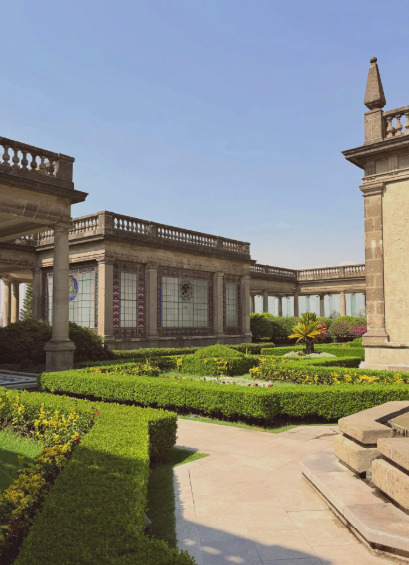
Chapultepec Castle is extraordinary in ways most visitors never discover. The standard tour covers the imperial apartments, the murals, the views — but the real story involves a poisoned viceroy, a 60-year private exile, a Baz Luhrmann film, and a carriage that became a political statement. Here are 15 facts about Chapultepec Castle that most people — including regular Mexico City visitors — don't know.
1. It Is the Only Royal Castle in the Americas
Every castle or palace in North and South America is either a colonial administrative building, a military fortification, or a private residence. Chapultepec Castle alone served as the official residence of a reigning monarch — Emperor Maximilian I of the Habsburg dynasty and Empress Carlota of Belgium — who ruled the Second Mexican Empire from 1864 to 1867. There is no comparable building anywhere on the American continents.
2. The Name Means "Hill of the Grasshopper"
"Chapultepec" combines the Nahuatl words chapulin (grasshopper) and tepetl (hill). A grasshopper is carved into the rock face of the hill itself — visible near the base on the approach path. The exact reason for the name is historically debated: some scholars believe it referred to the sound of insects in summer; others that it referenced a grasshopper clan totem of the first Aztec settlers in the area. Either way, the grasshopper has been the symbol of this hill for at least 600 years.
3. The Hill Was Sacred to the Aztecs for 400 Years Before the Castle
Chapultepec Hill was a ceremonial retreat for Aztec rulers from at least the 1300s. Moctezuma I had his portrait carved into the basalt rock face around 1467 — one of the earliest known examples of political portraiture in Mesoamerica. The hill's natural springs supplied fresh water to the Aztec capital Tenochtitlán via aqueduct. This pre-Hispanic significance is why the Spanish considered it worth building on at all.
4. The Viceroy Who Built It Was Probably Poisoned
Viceroy Bernardo de Gálvez commissioned the castle in 1785. He died in 1786, aged 38, after only two years in office. The official cause was listed as fever, but contemporaries suspected poison. Gálvez had accumulated significant personal power and popularity — unusually close to the local Mexican population, unusually critical of the Spanish merchant establishment. Powerful enemies in the colonial administration reportedly arranged his removal. The castle he built was left unfinished and stood largely abandoned for decades.
5. Maximilian Designed Paseo de la Reforma
Mexico City's grand boulevard — now one of the capital's most important streets, lined with monuments and flanked by skyscrapers — was designed by Emperor Maximilian as a private road connecting his hilltop castle to the city centre. He modelled it on the Champs-Élysées in Paris. After his execution in 1867, the republican government kept the road and renamed it. The Ángel de la Independencia, erected in 1910, now stands at its centre — a monument to Mexican independence built on an imperial road.
6. Carlota's Piano Is Still in Her Room
Empress Carlota's original Belgian-made piano remains in her music room exactly where it was placed during the imperial renovation of the 1860s. It has never been moved. It is one of the most evocative objects in the castle — silent for 160 years, in a room that once heard an empress play in a palace on a hill in Mexico City. See all of Carlota's rooms →
7. Carlota Outlived Maximilian by 60 Years
When Maximilian was executed in June 1867, Carlota was in Europe attempting to secure military support for the failing empire. She never returned to Mexico. She lived until 1927 — 60 years after Maximilian's death — in progressive mental deterioration at Château de Bouchout in Belgium, reportedly believing at times that she was still Empress of Mexico. She died aged 86, having spent more of her life in private exile than in any palace.
8. A Baz Luhrmann Film Was Shot Here
Baz Luhrmann's 1996 film Romeo + Juliet (starring Leonardo DiCaprio and Claire Danes) used Chapultepec Castle as a filming location for the Capulet mansion interior scenes. The castle's combination of European-style grandeur and photogenic detail suited the film's anachronistic, hyper-stylised aesthetic. Most visitors today walk through rooms that appeared in one of the 1990s' most successful Shakespeare adaptations without knowing it.
9. The Stained-Glass Windows Came from France in the 1860s
The Galería de Emplomados — the most photographed interior space in the castle — is lined with leaded stained-glass windows that were manufactured in France and shipped across the Atlantic during Maximilian's renovation. They were made using traditional European cathedral glassmaking techniques. The coloured light they cast across the gallery floor at 9:00–11:00 am is effectively the accidental result of a 160-year-old imperial design decision.
10. Juárez Refused to Live Here on Principle
After Maximilian's execution, republican President Benito Juárez returned to Mexico City and pointedly refused to take up residence in Chapultepec Castle. He considered it a symbol of foreign occupation and bourgeois excess incompatible with republican values — and he was a Zapotec from rural Oaxaca who had risen through law and politics, not through inherited wealth. His successors were less principled. Porfirio Díaz moved in and stayed for 35 years. The two state carriages displayed side by side in the castle's carriage room — Maximilian's gilded European coach versus Juárez's plain black republican vehicle — make this ideological contrast visible in a single glance.
11. The Observatory Was Used for Real Science
The Caballero Alto tower served as a functioning astronomical observatory in the late 19th century. At 2,325 metres above sea level — the highest point in Bosque de Chapultepec — it was ideal for observation before Mexico City's growth made urban astronomy impractical. The instruments are gone, but the tower provides the best panoramic viewpoint in the castle complex, with Popocatépetl and Iztaccíhuatl visible on clear days.
12. The Murals Were Commissioned as Political Arguments
The monumental murals by Siqueiros, O'Gorman, and Orozco weren't decorative additions. They were explicitly commissioned by post-revolutionary governments as visual arguments about Mexican national identity — who Mexico is, where it came from, and who its enemies were. Siqueiros's stairwell mural depicts the Díaz dictatorship and its violent overthrow. Orozco's painting shows Maximilian being handed to a firing squad. The castle's walls collectively present a highly editorialised version of Mexican history, and understanding that editorialisation is part of understanding the building.
Book early access guided tour from $83 →
13. 62 Colonial Governors Are Portrayed in One Room
The Sala de los Virreyes contains portraits of all 62 viceroys who governed New Spain between 1535 and 1821. Every one of them, in the same format: official dress, staff of office, identifying inscription. The cumulative visual weight of 62 nearly identical paintings on four walls — three centuries of colonial administration compressed into a single room — is historically striking in a way that individual portraits never achieve. See our architecture guide for what to look for in this room.
14. The Castle Sits on the Only Known Aztec Rock Carvings in Mexico City
The basalt hill beneath the castle contains the remains of Aztec rock reliefs — carved during the reign of Moctezuma I in the 15th century. They are weathered and largely invisible to the casual visitor, buried under and around centuries of colonial-era masonry. But they are there. The castle is not merely built near an Aztec site — it is built on top of one, and the hill's entire history runs beneath the floor you're walking on.
15. It Receives Over a Million Visitors Per Year
Chapultepec Castle is the most visited castle in the Western Hemisphere — more than a million visitors annually, more than any comparable building in North or South America. This is partly a function of location (one of the world's largest cities) and partly because the 210 MXN admission price keeps it genuinely accessible. Its combination of pre-Hispanic history, colonial architecture, imperial renovation, and post-revolutionary muralism makes it unique — there is nothing else quite like it anywhere in the world.